How the League of Legends Ranking System Works in 2026
By LOLValue Team · May 27, 2026
From MMR and LP to Solo/Duo and Flex Queues, Ranked Play Gives Every Match A Place
Understanding the League of Legends Ranked Climb
If you are about to test your skills on the Rift but still feel unsure about how the League of Legends ranking system works, this guide should help. A lot of new players think ranked means being thrown straight into matches against veterans with far more experience. It can feel intimidating from the outside, especially when people talk about LP, MMR, tiers, queues, and promotion pressure as if everyone should already know the language.
The system is not as confusing once you break it down.
How Does the LoL Ranking System Work?
LoL ranking works like a climb, and your goal is to win matches and move upward, but the game does not only look at the rank you can see. Behind that visible badge, Riot also uses MMR, or Matchmaking Rating, to match you with players of similar skill. Riot explains MMR as the hidden number that rises when you win and falls when you lose, while your rank turns that level into something easier to read: tiers, divisions, and LP.
LOL Ranks
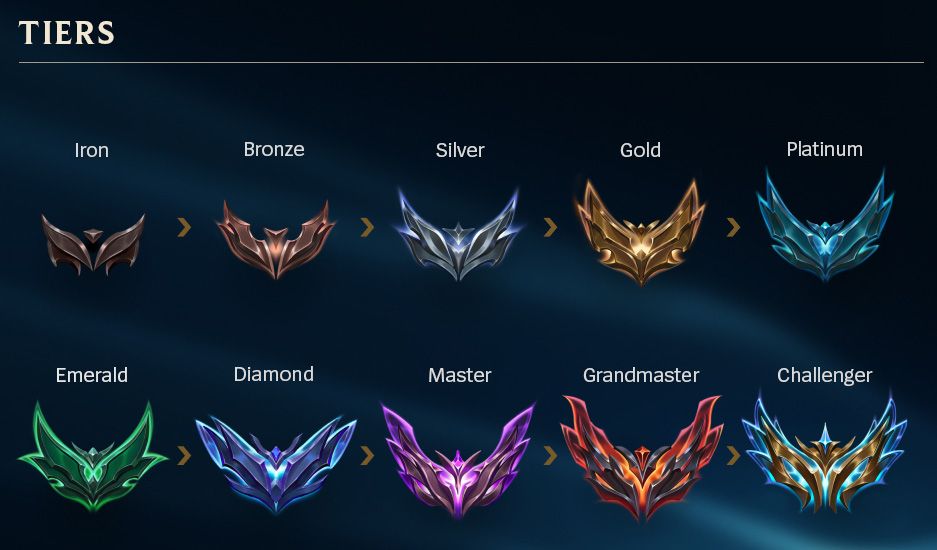
The league ranks in order are:
- Iron
- Bronze
- Silver
- Gold
- Platinum
- Emerald
- Diamond
- Master
- Grandmaster
- Challenger
These League of Legends ranked tiers are the visible structure they tell you where you stand, how far you have climbed, and how much harder the ladder gets near the top.
LOL Divisions
Most ranks are divided into smaller steps. From Iron through Diamond, every rank has four divisions: IV, III, II, and I. Division IV is the lowest point in that rank. Division I is the final step before moving up.
LP, or League Points, controls that movement. You gain LP after wins and lose LP after losses. When you reach 100 LP in a division, you move up. If you reach 100 LP in Division I, you move into the next rank. Gold I, for example, becomes Platinum IV.
Master, Grandmaster, and Challenger work differently because they sit at the top of the ranked ladder.
How Ranked Play Connects to the Competitive Scene
Ranked is the natural entry point into the League's competitive scene. It is the first public filter for skill, consistency, mechanics, and individual decision-making.
As players climb, they gain visibility to step into the pro scene. A high-ranked account does not automatically make someone a pro prospect, but it puts them closer to the big arena.
Coaches, scouts, amateur teams, and competitive communities often look at ranked performance as an early signal.
Why the Ranking System Matters in Professional League of Legends
The ranked system matters because it works as the first major showcase of competitive talent. Before a player reaches a professional league, they usually need to show they can perform consistently at the top of the ladder: Master, Grandmaster, or Challenger.
Understanding ranked tiers also helps fans. If you know how the ladder works, you can better judge a player’s form, their reputation, and how impressive their climb really is. It also gives more context to the wider esports conversation, including League of Legends betting markets around major events, where team quality and player performance are constantly being evaluated.
From Solo Queue to Esports Competition
Queues are the ranked modes available in League of Legends. The two main ranked queues are:
- Solo/Duo
- Flex
Each queue has its own rank. You can be Gold in Solo/Duo and Silver in Flex because progress in one queue does not directly affect the other. Riot notes that Solo/Duo and Flex ranks are separate, with rewards also tied to each queue.
Solo/Duo is where you play alone or with one friend. It measures individual impact more directly when it comes to mechanics, map awareness, quick communication, and the ability to adapt to strangers.
Solo Queue often becomes the first contact point between a talented player and the broader competitive world. It is where many players prove they can win consistently against strong opponents.
Flex, meanwhile, is built more around team structure. It is useful for practicing compositions, grouped fights, coordination, and preparation for organized formats like Clash.
When Will the Ranked Season End in LoL 2026?
For 2026, the first season ended around late April. The second season runs after that into the middle part of the year, while the final stretch carries players toward the beginning of January.
Players should still check the client or Riot’s official support updates for exact cutoffs, since dates can shift by region or patch timing.
Is League of Legends Still Popular in 2026?
Yes. League of Legends remains one of the biggest games in the world, both for casual players and for esports. Public estimates vary, but most place the game well above 100 million monthly active players.
More from the LOLValue blog
LoL account value calculator · LoL skins database · LoL MMR checker · Wasted on LoL · Riot Points to USD
LoLValue isn't endorsed by Riot Games and doesn't reflect the views or opinions of Riot Games or anyone officially involved in producing or managing Riot Games properties. Riot Games, and all associated properties are trademarks or registered trademarks of Riot Games, Inc.