Beyond the Tier List: How MetaBot.GG Helps League of Legends Players Make Better Decisions
By LOLValue Team · July 15, 2026
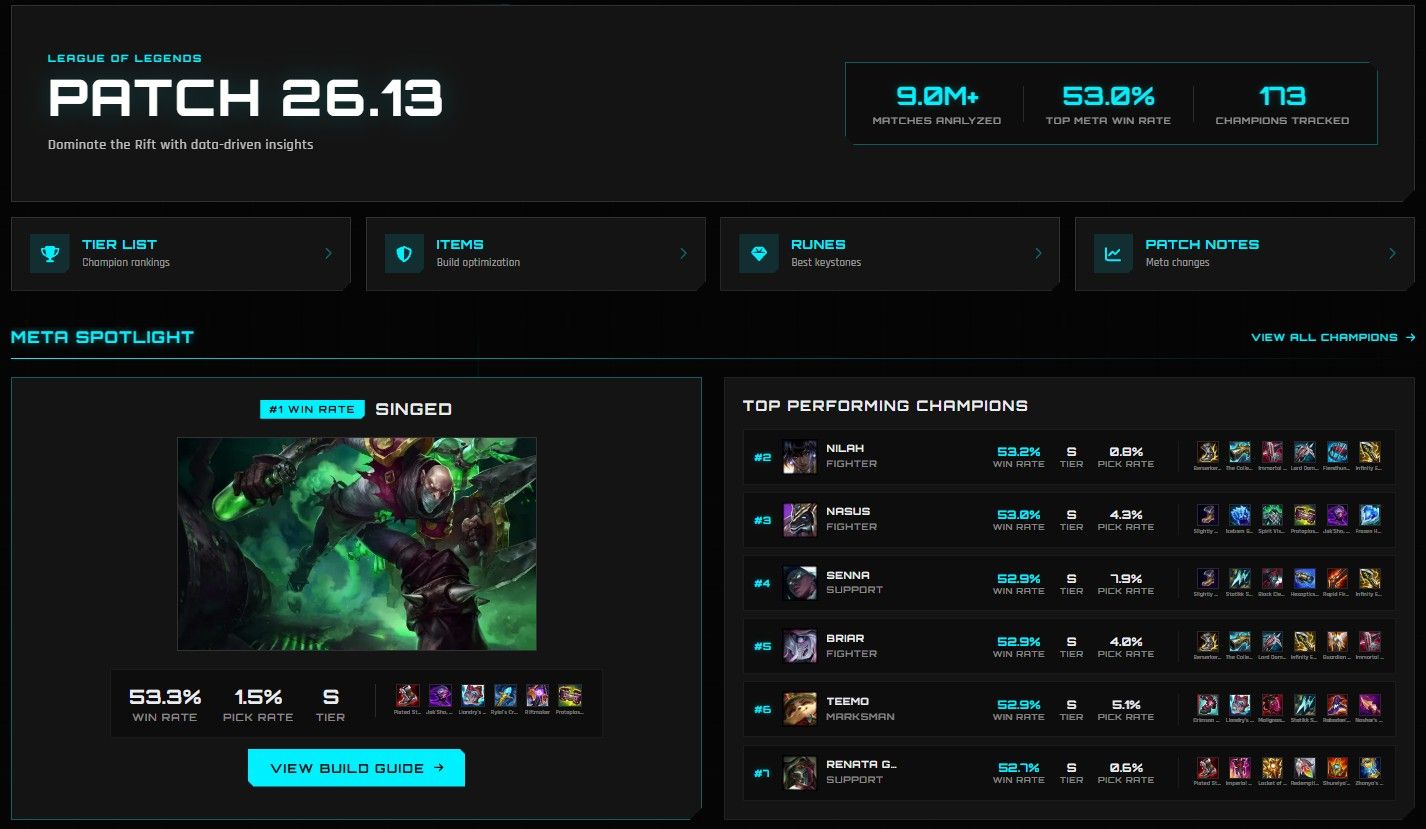
League of Legends players have never had more information available to them. Before entering a match, you can check a champion's win rate, copy a popular build, review a matchup, study the latest patch changes, and look up almost any mechanical interaction in the game.
The problem is no longer finding information. The real challenge is figuring out which information actually matters.
A champion with a high overall win rate may be weak in your preferred role. The most popular item may not be the best-performing option. A supposed counterpick may only work when played correctly, while a statistically unfavorable matchup could still suit your personal playstyle. Raw numbers can be helpful, but only when they are presented with enough context to turn them into decisions.
That is the problem MetaBot.GG's League of Legends statistics are designed to address. Instead of reducing the current meta to a single tier list, the platform organizes recent match data into champion rankings, builds, runes, matchups, items, patch trends, and tools that players can use before and after entering the queue.
Why League Statistics Need Context
Win rate is usually the first number players look at, but it is rarely enough on its own. Imagine that two champions both have a 52% win rate. One has been played in hundreds of thousands of matches by players across every rank, while the other is primarily used by a small group of experienced specialists. The number may be identical, but the meaning behind it is very different.
Pick rate, ban rate, role, rank, matchup frequency, item order, and sample size can all change how a statistic should be interpreted. Even the timing of the data matters. Results gathered immediately after a patch may be more volatile than statistics collected after players have adjusted to the changes.
MetaBot approaches the game from several angles rather than asking players to trust one headline number. Its League hub provides access to champion performance, tier rankings, builds, items, runes, matchup information, ARAM data, Arena statistics, and patch movement. This makes it possible to move from a broad question such as "Which champions are strong?" to a much more useful question: "Which champion is performing well in my role, and how should I build it into the matchup I am about to play?"
Starting with the Right Champion
Tier lists are useful for getting a quick view of the meta, especially after a balance update. They can show which champions are rising, which picks are falling behind, and where the strongest overall performers currently sit.
However, a good champion choice involves more than selecting the character at the top of a list. Players also need to consider comfort, role flexibility, team composition, damage profile, scaling, and matchup difficulty.
MetaBot's champion pages let players investigate those details individually. A player can begin with the overall rankings, open a champion that fits their preferred role, and then examine how that champion performs in more specific situations. This is especially valuable for players trying to build a small ranked champion pool. Instead of constantly switching to whichever character currently has the highest win rate, they can look for champions that combine solid performance with a playstyle they are willing to practice consistently.
That distinction matters because the statistically strongest champion is not automatically the strongest champion for every player. Someone with fifty games on their main will usually understand damage limits, trade patterns, cooldowns, and difficult matchups better than someone first-timing a slightly higher-ranked pick.
More from the LOLValue blog
LoL account value calculator · LoL skins database · LoL MMR checker · Wasted on LoL · Riot Points to USD
LoLValue isn't endorsed by Riot Games and doesn't reflect the views or opinions of Riot Games or anyone officially involved in producing or managing Riot Games properties. Riot Games, and all associated properties are trademarks or registered trademarks of Riot Games, Inc.