LCS 2026 Spring Split Playoffs brought 22% more viewers - but is the trend real?
By LOLValue Team · June 4, 2026
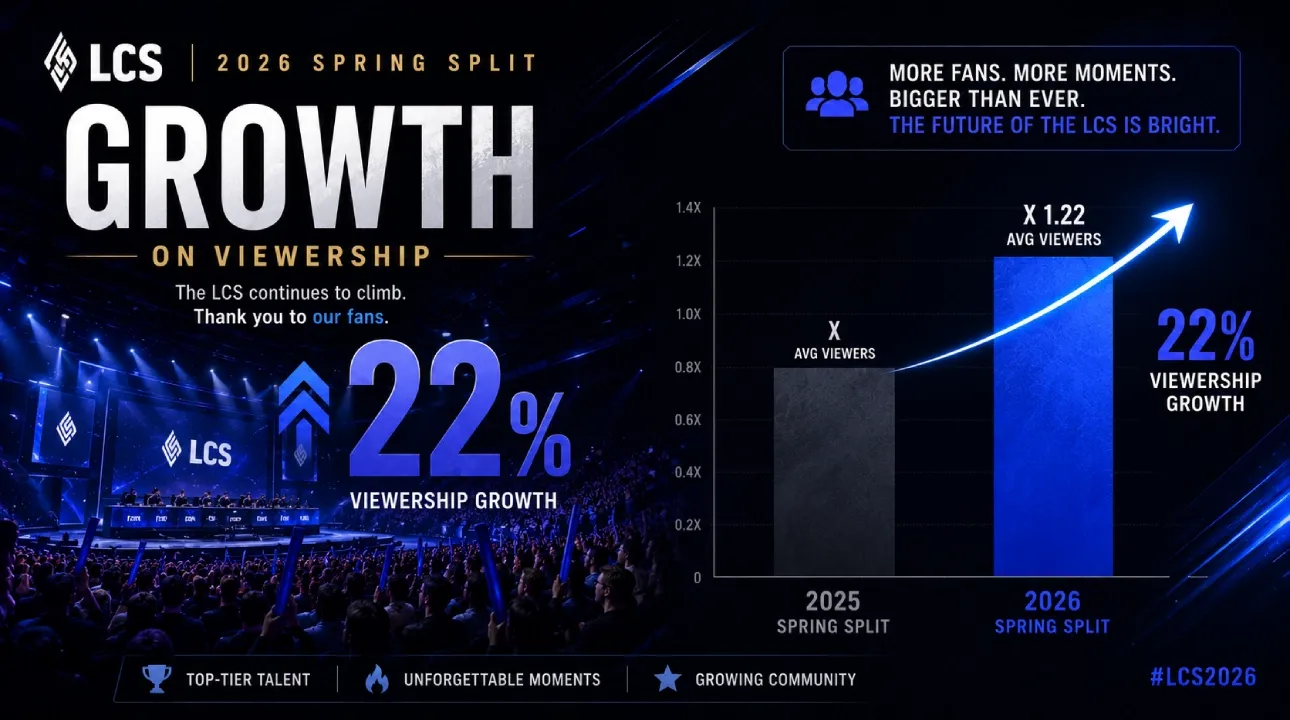
The LCS 2026 Spring Split Playoffs drew a 22% viewership increase compared to the equivalent stage of the previous split, putting North American League of Legends in a rare position: genuine, measurable growth. After years of declining numbers under various brand identities, including a full calendar year under the broadly unpopular LTA North banner, any upward movement matters. The question is whether this spike reflects a real audience shift or just the short-lived excitement of a revived brand.
According to Esports Charts, the LCS 2026 Spring peaked at 79,986 concurrent viewers on May 3, 2026, with 2,277,793 total Hours Watched across the split's 44 hours of broadcast. Those numbers aren't historic. The LCS has seen six-figure peak viewership across many playoff runs. But put alongside the 2025 LTA North figures – where the second and third splits scraped around 147,000 and 159,000 peak viewers respectively across their full runs, not just playoffs –the Spring 2026 playoff period tells a cleaner story than the raw peaks suggest.
What drove the 22% rise in LCS Spring 2026 playoffs viewership?
Three factors combined to push the Spring Playoffs above prior-split benchmarks. First, the brand. The LCS name returned for the 2026 season after Riot Games announced the dissolution of the LTA at the September 28, 2025 LTA Championship finals. Fans had been vocal about their frustration with the pan-American experiment, and the return of LCS branding brought back a recognizable identity that the casual North American audience could find again on Twitch and YouTube.
Second, the storylines entering playoffs were stronger than usual. Cloud9 came in as the dominant regular-season force. LYON – the Mexican organization that joined the LCS as a partner team following the LTA's collapse – had already proven during the January–March Lock-In tournament that they could win in North America, defeating Cloud9 3:1 in the Lock-In grand final on March 1, 2026. That history made the Spring Playoffs rematch potential impossible to ignore. FlyQuest and Team Liquid brought in established North American fan bases. Sentinels, meanwhile, joined the league for 2026 following 100 Thieves' departure, and brought with them a crossover audience that doesn't typically watch the LCS.
Third, co-streaming. According to Esports Insider's coverage of the Lock-In, a meaningful share of playoff viewers came through co-streams, with LEC broadcaster Marc "Caedrel" Lamont driving notable traffic during the grand final period. That same pattern carried into Spring. Caedrel's coverage and LEC post-stream redirects represent an audience pipeline that NA LoL hasn't consistently had before.
How does the LCS Spring 2026 playoff peak compare to past splits?
Context is important here. For fans who track gaming news today and want a quick read on where NA LoL actually stands, the comparison needs to be specific, not just directional. The LCS 2026 Lock-In tournament peaked at 184,969 viewers during the March 1 Cloud9 vs. LYON grand final –the highest LCS playoff peak in several years – but the Lock-In format inflates peak numbers because it attaches direct First Stand qualification to the winner, raising the stakes artificially. The Spring Playoffs don't carry the same singular qualification pressure; two teams advance to MSI rather than one team to First Stand.
Looking at comparable formats, the LTA North Split 1 grand final between 100 Thieves and Team Liquid peaked at 170,313 viewers, according to Esports Charts data cited by Sheep Esports. The Spring 2026 Playoffs don't hit those peak numbers, but the difference lies in consistency. The Spring run held a higher floor across multiple playoff series rather than concentrating all viewers into a single final. Average viewership for the Spring at 51,965 per broadcast hour is a meaningful improvement over the regular season numbers from comparable 2025 splits.
According to the Liquipedia LCS 2026 Spring page, the Spring Playoffs follow a double-elimination bracket format with all matches played as best-of-fives, with the top two teams qualifying for the 2026 Mid-Season Invitational. That MSI qualification spot matters for viewership: teams competing for Daejeon attendance attract more invested viewers than a standard split trophy.
Why the Spring Finals venue matters for future viewership
Riot's decision to move the LCS 2026 Spring Finals to ASU's Mullett Arena in Tempe, Arizona on June 13–14 is the biggest structural change affecting viewership momentum. The Spring Finals will be the LCS's first event outside Los Angeles since the 2023 Summer Split finals at the Prudential Center in Newark, New Jersey. Road shows consistently produce viewership spikes in other leagues – the LEC's run through European cities, and the LCK's occasional arena events, both generate local buzz that translates into online viewership.
Whether that pattern holds in North America is an open question, but the precedent is solid. Local media coverage, new venue energy, and fans attending who wouldn't travel to LA all contribute to broadcast momentum. If Cloud9 or Team Liquid advance deep, their fanbases have the size to move numbers in real time. LYON, despite their Lock-In win, draws a more specific Latin American audience that tends to concentrate on Kick and YouTube rather than Twitch.
What 22% growth actually means for NA League of Legends
That 22% figure tells you something real but limited. North American League of Legends is, by global standards, a small-audience product. As Esports Charts noted in their Lock-In viewership analysis, the LCS remains the least-watched Worlds circuit league outside mainland China – the LCK regularly clears one million concurrent viewers during its biggest matches, a number the LCS hasn't approached in years.
A 22% jump in playoff viewership means the audience is more engaged during high-stakes moments, which is exactly what you want to see heading into an MSI year. It doesn't mean the regular season is fixed. It doesn't mean the average North American LoL fan is back to watching weekly. But it does mean that the playoff product, with real international stakes attached, pulls people back who had quietly drifted away during the LTA experiment.
Riot's structural changes for 2026 – three-split format, MSI qualification from Spring, Worlds 2026 hosted in North America across Allen, Texas and New York – give the LCS a calendar with genuine anchor points throughout the year. If each of those moments generates even modest viewership growth, the cumulative picture by November looks meaningfully different from 2025.
The Spring Playoffs gave NA LoL fans a reason to watch. What the Summer Split does with that momentum is the next question worth tracking. If you want to follow the Summer Split as it happens, you can keep up with every result through live lol matches.
More from the LOLValue blog
LoL account value calculator · LoL skins database · LoL MMR checker · Wasted on LoL · Riot Points to USD
LoLValue isn't endorsed by Riot Games and doesn't reflect the views or opinions of Riot Games or anyone officially involved in producing or managing Riot Games properties. Riot Games, and all associated properties are trademarks or registered trademarks of Riot Games, Inc.