How to Master the Fortnite Rank System: From Bronze to Unreal in 2026
By LOLValue Team · February 23, 2026
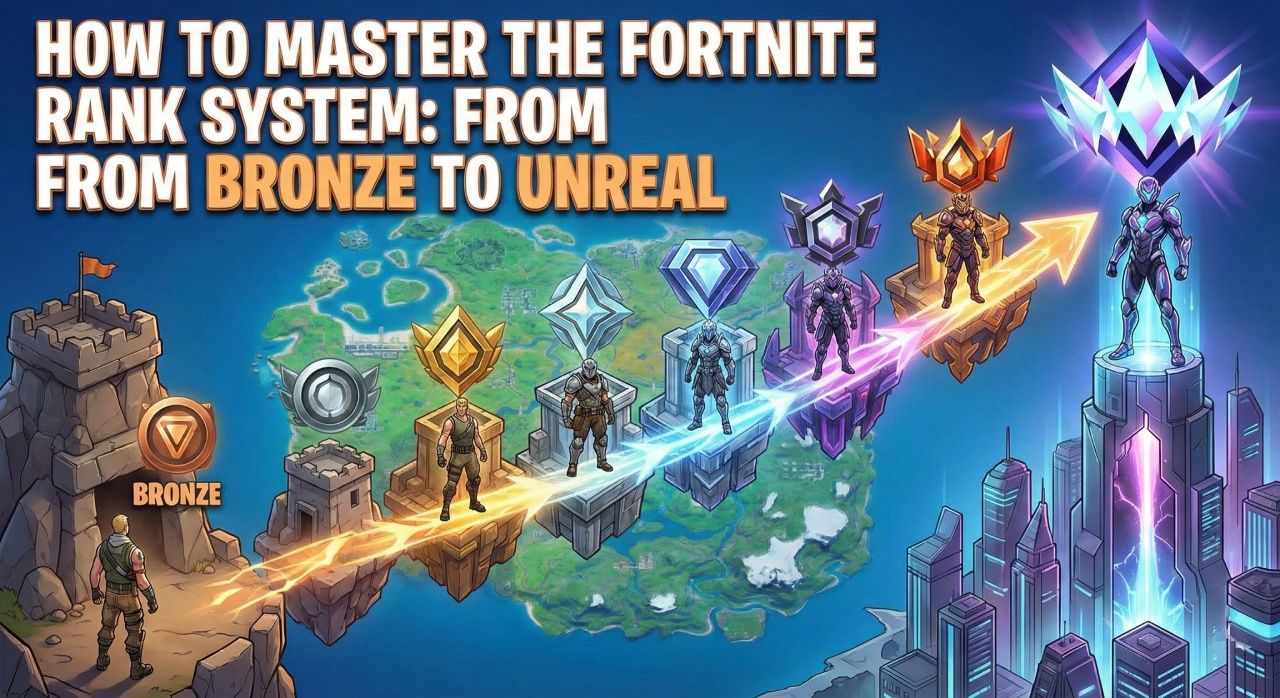
Fortnite's competitive scene has evolved into one of the most demanding ranked environments in battle royale gaming, with 500 million players worldwide competing across its structured tier system. The ranking system creates a clear competitive hierarchy where reaching Diamond I places you among the top 13% of players globally, while Unreal rank represents the ultimate achievement reserved for only the top 0.5%.
The current Fortnite ranking system operates through eight distinct ranks spanning 18 total tiers, each serving as a benchmark for player skill progression. Understanding how these ranks function and what separates each tier becomes essential for anyone serious about climbing the competitive ladder.
This breakdown covers the ranking system mechanics, effective strategies for consistent advancement, and the specific requirements needed to reach the highest competitive tiers in 2026.
Fortnite Ranking System Mechanics in 2026
Ranked Mode Access and Placement
Ranked mode unlocks after completing the Outlast 500 Players quest from your Kickstart objectives. Once accessible, you can toggle ranked on or off through the mode selection screen in your lobby. Ranked matches use tournament-style loot pools and pair you exclusively with other players who have ranked enabled.
Initial rank placement considers your historical match performance alongside your first ranked game results in each mode. A single ranked match reveals your starting position. Your rank emblem appears on the lobby's right side, with a hover tooltip displaying progress toward promotion or demotion.
Performance Calculation System
Fortnite's ranking algorithm evaluates multiple performance metrics simultaneously:
Match Placement serves as the primary ranking factor. Players finishing in the top 30% earn positive rank progression, while the top 5% receive substantial bonuses. The bottom 40% of finishers now lose more rank than in previous seasons.
Elimination Value varies based on timing and opponent strength. Late-game kills carry significantly more weight than early eliminations. The system also considers the ranks of players you eliminate, awarding additional points for defeating higher-tier opponents.
Team Dynamics in duos and squads create party ranks equivalent to your highest-ranked teammate. A squad containing Gold I, Silver I, Silver I, and Bronze II players operates at Gold I party rank.
Players reaching Unreal rank maintain that status for the entire season. However, they receive numerical standings among all Unreal players, tracked on a dedicated global leaderboard.
Battle Royale vs Zero Build Progression
The ranking system maintains completely separate progressions for Battle Royale and Zero Build modes. Your advancement in one mode has no impact on the other, allowing independent skill assessment across both formats.
Battle Royale ranked hosts approximately 4.7 million active players, with the average competitor sitting around Gold I or Gold II. Zero Build attracts roughly 1 million ranked players, with an average rank of Silver II. This disparity reflects Zero Build's appeal to newer players, while Battle Royale draws veterans who've mastered building mechanics.
Zero Build rank progression moves slower due to a smaller player pool making high-rank matchmaking difficult, gameplay that offers less defensive options, and a demographic focused more on accessibility than competitive depth.
MMR vs Visible Ranking
Epic Games operates a dual-layer system combining visible ranks with hidden MMR (Matchmaking Rating). Your MMR tracks true skill level independently from displayed rank, with matchmaking pairing players based on MMR rather than identical visible tiers.
This prevents rank inflation while maintaining competitive integrity. MMR determines point gains and losses per match and influences lobby composition. Higher skill levels result in fewer bot opponents appearing in your matches. The system functions across all regions and has improved smurf detection capabilities since 2025 updates.
Fortnite Rank Distribution and Player Skill Analysis
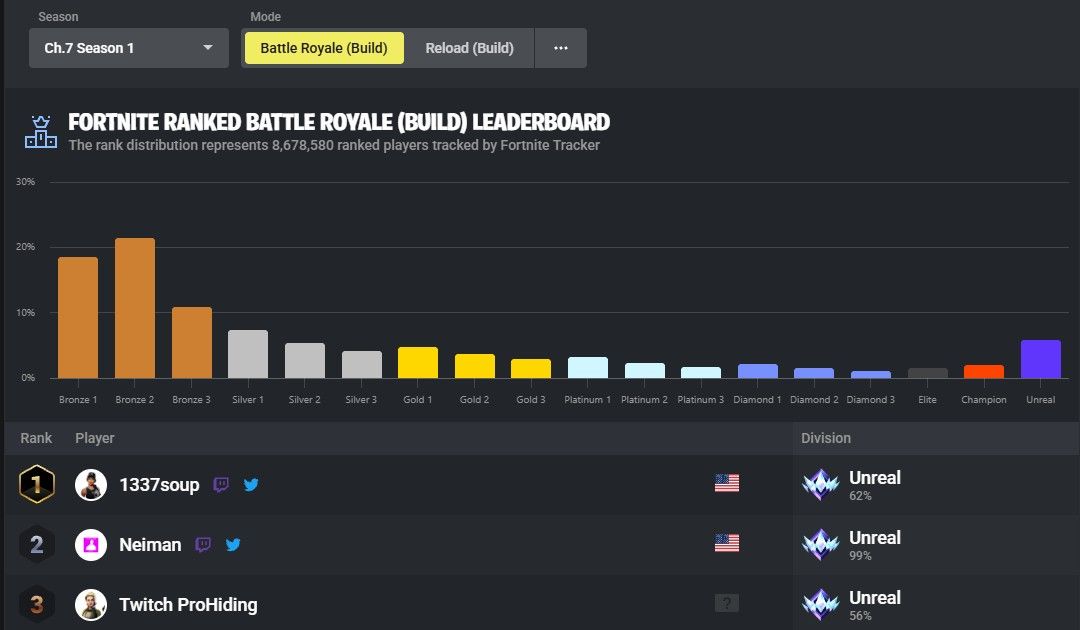
Eight main ranks structure Fortnite's competitive ladder, with Bronze through Diamond featuring three subdivisions each, while Elite, Champion, and Unreal operate as standalone tiers.
Bronze Rank (Tiers I-III)
The entry point for competitive Fortnite houses approximately 21% of all ranked players, with Bronze I specifically containing 17% of the total player base. Bronze II represents the highest concentration at 22.6%, making it one of the most populated individual tiers across the entire system.
Players at this level focus on fundamental mechanics including building under pressure, rotation timing, and inventory management. The skill variance proves substantial, as genuine newcomers compete alongside experienced players climbing back after seasonal resets.
Silver Rank (Tiers I-III)
Silver represents the most populated division, containing roughly 30% of the entire ranked community. Silver I alone accounts for 9.9% of players, establishing it as the single most common rank across both Battle Royale and Zero Build modes.
These players understand basic game mechanics but lack consistency in execution. Decent building fundamentals and tactical awareness appear regularly, though material management problems and editing hesitation continue to limit advancement. The average Zero Build player sits at Silver II.
Gold Rank (Tiers I-III)
Gold accommodates approximately 23% of ranked players and marks where casual competitive play transitions into serious ranked commitment. The average Battle Royale competitor lands around Gold I or Gold II.
Solid game sense, meta loadout understanding, and rare unforced errors characterize this tier. Positioning mistakes become significantly more costly as opponents capitalize on tactical errors. Third-party situations increase dramatically, with skilled players exploiting ongoing engagements.
Platinum Rank (Tiers I-III)
Roughly 14% of players reach Platinum, representing mechanically proficient competitors who rank among the top 25% globally. Box fighting efficiency, calculated aggression, and ruthless exploitation of positioning errors define opponents at this level.
Advanced building techniques, edit plays, and optimal rotation strategies become standard. Storm positioning knowledge and high-ground advantages prove critical for consistent success.
Diamond Rank (Tiers I-III)
Only 8% of players achieve Diamond rank, signaling entry into high-level competitive play. Diamond I specifically places you among the top 13% of players worldwide.
High-level building, editing, and aim tracking skills become prerequisites. Competitors maintain intense pace throughout matches, with mistakes receiving severe punishment. Lightning-fast edits, strategic utility usage, and disciplined fight selection separate Diamond players from lower tiers.
Elite, Champion, and Unreal Ranks
Elite rank encompasses roughly 2% of players and demands exceptional mechanical skill. Demotion protection activates once you reach Elite, securing your position for the remainder of the season.
Champion contains approximately 1% of ranked players, hosting tournament-caliber competitors. Like Elite, Champion rank cannot be lost once achieved.
Unreal represents the pinnacle achievement, reserved for the top 0.5% of players. Players maintain permanent Unreal status once achieved, with current statistics showing roughly 5% at this level.
Strategies for Efficient Rank Climbing
Consistent Placement Over Elimination Hunting
The ranking system prioritizes steady performance rather than spectacular highlight reels. Players who average 3-5 eliminations while maintaining consistent top-10 finishes advance significantly faster than those pursuing 10+ kill games but finishing 15th place. The system evaluates performance across multiple matches rather than individual victory royales, meaning sustained placement success with moderate eliminations outweighs occasional high-kill defeats.
Early-game elimination chasing delivers minimal ranking progress since these kills contribute less toward advancement. Late-game eliminations carry substantially more weight in the ranking calculations. Target weakened squads already engaged with other teams rather than initiating fights against full-strength opponents. This strategy maximizes elimination value while minimizing unnecessary risk exposure.
Zone Rotation Mastery
Rotation skills separate Platinum competitors from Diamond-level players more effectively than raw mechanical ability. Study storm movements and identify natural cover routes through terrain features, existing structures, and landscape elements. Early rotation prevents storm damage while securing superior positioning before final circles compress.
Open field movements during late-game phases expose players to third-party eliminations from multiple angles. Position yourself on the storm's dead side or work toward low-pressure circle edges rather than contesting central high-traffic areas. Strategic mobility item usage ensures optimal final circle positioning.
Strategic Landing Zone Selection
Quiet drop locations away from the initial bus trajectory allow safe looting while avoiding immediate confrontations. Popular contested areas drain materials and health before mid-game positioning becomes crucial. Master specific landing spots with established loot routes and known rotation pathways.
Classified Canyon's vault guarantees rare chest spawns and a gold Lightning Gun. The northern dock area near Tiptop Terrace features reliable Slurp Truck spawns alongside barrel clusters for immediate shield restoration. Inoloop Labs offers underground tunnel systems connecting five different exits, enabling secure rotations and third-party escape routes.
Material Economy Management
Build resource economy directly correlates with survival probability and final placement statistics. Players maintaining over 100 builds at Zone 4 achieve 92.6% survival rates to Zone 5, compared to only 50% survival for players with 50 or fewer builds remaining. Prioritize material farming through Zone 2, then carefully manage stockpiles during mid-game transitions.
Wood serves effectively for low-ground tunneling during non-pressure situations, while brick and metal should be reserved for endgame defensive structures and high-intensity combat scenarios. Position defensive bases near renewable material sources whenever circle positioning allows.
Team Coordination Advantages
Solo queuing in duo or squad modes significantly hampers ranking progression. Random teammates frequently lack communication protocols, execute questionable rotation decisions, or abandon engagements mid-fight. Consistent partnerships with similarly skilled players who communicate effectively can double climbing efficiency. Platforms like GameTree facilitate connections with compatible teammates for reliable duo arrangements.
Common Mistakes That Keep Players Stuck in Lower Ranks
Rank progression stalls occur when players repeat fundamental errors that counteract their mechanical improvements. These mistakes become more costly as you face stronger opponents in higher tiers.
W-Keying Without Strategic Purpose
W-keying refers to aggressive forward pushes during every engagement opportunity. This playstyle succeeds against weaker opponents but fails against skilled competitors who capitalize on overaggression. The current ranking system prioritizes placement over elimination count, making mindless aggression counterproductive.
Players who chase high-kill games without considering lobby strength often plateau in Gold or Platinum ranks. Securing consistent eliminations throughout matches demonstrates superior skill compared to camping for endgame eliminations, yet reckless pushing without evaluating opponent positioning sabotages rank advancement.
Zone Positioning Neglect
Single-box camping restricts visibility and wastes valuable building materials. Players with sufficient resources should construct multiple connected boxes for enhanced scouting capabilities and rotation flexibility. Build mode allows passive resource farming and late-game positioning, making fight avoidance a viable climbing strategy.
Zero Build mode demands superior rotation skills since engagements become unavoidable without building defenses. Always scout your surroundings before rotating to identify potential threats from behind. Poor zone positioning becomes increasingly punishing as you advance through higher ranks.
Endgame Decision Failures
Duo partners who separate during final circles almost guarantee match losses. Maintain close proximity rather than splitting without clear coordination. Coordinate shockwave timing through countdown calls to ensure simultaneous jumps.
Crashpad users who open only single tiles avoid overshooting intended positions and losing advantageous spots. Storm damage during late-game rotations often determines match outcomes. Constructing 2x1 or 2x2 rotation structures provides superior control and visibility compared to standard solo boxes.
Skipping Warmup Routines
Effective preparation involves aim training, edit practice, and building drills across multiple creative maps. Piece control scenarios combined with aim duels activate different mechanical systems simultaneously. Players who skip warmup sessions experience reduced reaction times, compromised precision, and diminished focus.
Extended gaming sessions without adequate breaks create mental fatigue that severely impacts decision-making quality. Consistent warmup routines separate dedicated climbers from players who remain stuck at their current ranks.
Advanced Strategies for Diamond and Higher Ranks
Storm Surge Mechanics
Storm Surge represents one of the most critical late-game mechanics that separates Diamond players from lower ranks. The system activates when player counts exceed specific thresholds during storm phases, designed to force engagement and maintain server performance. Players who have dealt the least damage receive 25 damage every 5 seconds until the lobby population drops below zone requirements.
Zone 2 triggers Storm Surge at 64+ players, Zone 3 at 54+ players, while Zones 4 and 5 activate at 44 and 40 players respectively. Surviving Storm Surge requires approximately 150-200 damage dealt throughout the entire match, not just when the mechanic begins. This damage accumulates from the start of the game, making early-game positioning and third-party opportunities crucial for high-level play.
Box Fighting and Edit Execution
Advanced edit techniques become essential for Diamond-level competition. Double-layer cone-into-ramp configurations provide defensive positioning while enabling aggressive peaks. The left-hand peanut butter edit combined with right-hand peek positioning creates situations that appear 50/50 but actually favor the skilled player.
Constant angle switching during aggressive sequences makes movement patterns unpredictable and harder to counter. Timing becomes critical - waiting briefly after completing edits before taking shots exploits opponents who expect immediate visibility and often prefire incorrectly.
Fight Selection and Rotation Timing
Loadout quality directly determines your aggression approach in high-level matches. Strong inventory enables confident engagements, while ammo shortages or unfamiliar weapons require conservative play. Early-game lobbies contain more bot opponents and chaotic loot contests, whereas late-game concentrates skilled players in compressed circles where third-parties punish every engagement.
Siphon mechanics reward aggressive play when you control the engagement terms. The key lies in balancing calculated fights with safe rotations rather than forcing every available encounter.
Performance Optimization Settings
Performance mode delivers maximum FPS advantage for competitive play. Optimal settings include fullscreen window mode, disabled VSync, and frame rate capped at unlimited or matching your monitor's refresh rate. View distance set to Near, textures on Low, and all visual effects disabled boost performance while maintaining player visibility.
NVIDIA Reflex Low Latency set to "On + Boost" significantly reduces input lag. Fullscreen mode prioritizes Fortnite processing over background applications, minimizing input lag during crucial moments.
Conclusion
Fortnite's ranking system rewards strategic gameplay and consistent performance over highlight-reel eliminations. The current structure clearly separates casual players from competitive performers, with placement and late-game contributions carrying significantly more weight than early-game aggression.
Safe rotations, optimized landing zones, and disciplined zone positioning form the foundation of successful rank progression. Players who eliminate common mistakes like overaggression and poor endgame coordination advance more reliably than those focused purely on mechanical skill.
The path from Bronze to Diamond relies on these fundamental principles, while reaching Elite, Champion, and Unreal demands mastery of advanced mechanics like Storm Surge management and precise box fighting techniques.
Consistent practice and strategic decision-making drive long-term rank improvement. The 2026 ranking system provides clear benchmarks for measuring progress, making deliberate skill development the most reliable approach to climbing the competitive ladder.
More from the LOLValue blog
LoL account value calculator · LoL skins database · LoL MMR checker · Wasted on LoL · Riot Points to USD
LoLValue isn't endorsed by Riot Games and doesn't reflect the views or opinions of Riot Games or anyone officially involved in producing or managing Riot Games properties. Riot Games, and all associated properties are trademarks or registered trademarks of Riot Games, Inc.